17 June 2026
LearnFire Risk Assessment for Farm Shops and Farm Attractions: A Complete Guide
This guide is for information only and does not constitute professional fire safety advice. For complex premises or where fire risk is significant, engage a qualified fire risk assessor. Your local fire and rescue service can provide free advisory visits to farm businesses.
Fire risk assessment is a legal requirement — not optional
The Regulatory Reform (Fire Safety) Order 2005 requires the responsible person for any non-domestic premises to carry out a suitable and sufficient fire risk assessment. This applies to farm shops, farm cafés, farm attractions, PYO operations, glamping sites and any farm building open to staff or the public. For businesses with five or more employees the assessment must be in writing. Failure to comply is a criminal offence.
Opening a farm shop, café, or visitor attraction adds a layer of fire safety responsibility that a purely agricultural operation doesn't face — members of the public on the premises, commercial cooking equipment, retail storage, and potentially overnight glamping guests. Each of these brings specific fire risks that need to be identified and managed.
This guide covers the key risk areas for farm shops and farm attractions, the six-section fire risk assessment format accepted by fire services, the right fire extinguisher for each location, and a blank template you can complete for your own premises.
Highest-risk areas for farm shops and attractions
🍳 Farm café and commercial kitchen — Very High risk
Commercial cooking equipment is one of the leading causes of fire in retail and hospitality premises. Deep fat fryers, commercial grills, and extraction ducts accumulate grease over time — a duct fire can spread rapidly through a building. Cooking oil fires are also extremely dangerous if tackled with the wrong extinguisher.
Common ignition sources
- Overheated cooking oil in fryers — thermostat failure or unattended cooking
- Grease accumulation in extraction ducts — can ignite from heat alone
- Electrical faults in commercial appliances — ovens, grills, toasters
- Combustible materials too close to cooking equipment
- Unattended cooking — the most common cause of kitchen fires
Control measures
- Extraction duct cleaning contract — minimum every 6-12 months depending on usage
- Automatic suppression system on commercial fryers in high-volume kitchens
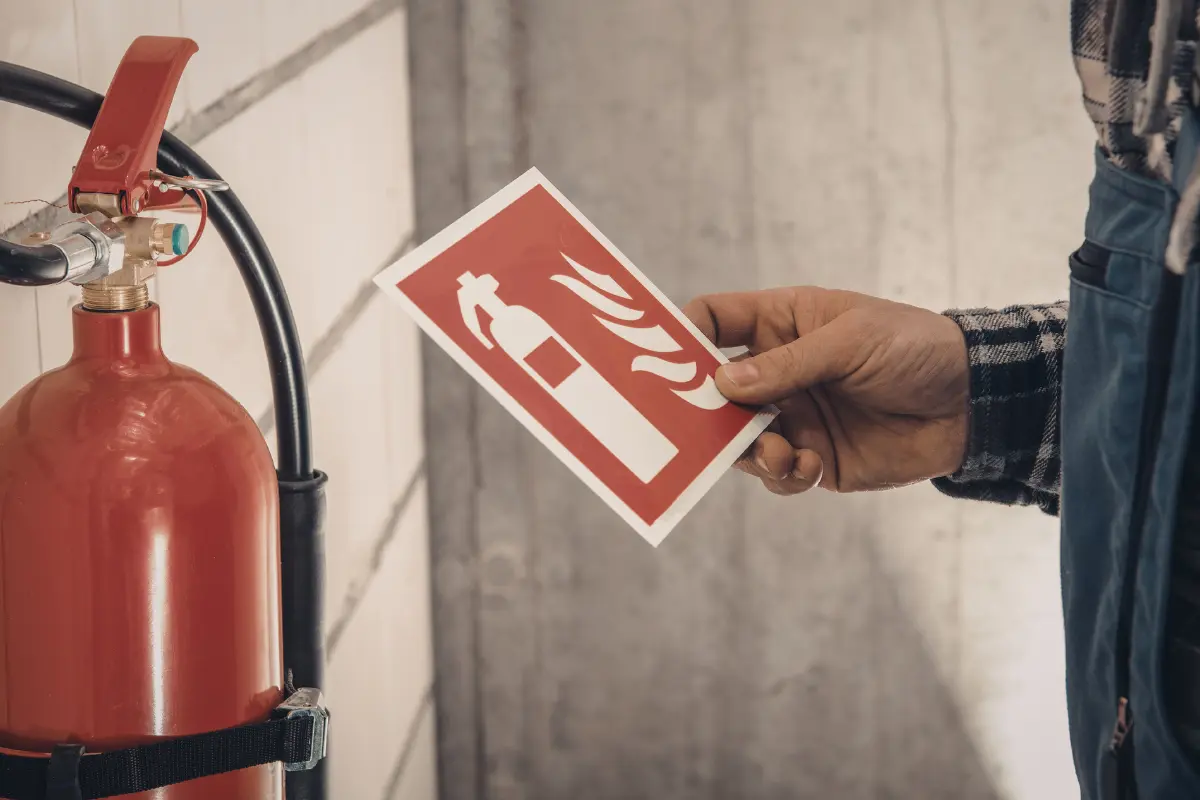
- Wet chemical extinguisher (yellow) and fire blanket mounted adjacent to cooking area
- Never leave cooking equipment unattended — policy and staff training
- Annual service of all commercial cooking appliances
- Heat detector (not smoke detector) in kitchen — cooking fumes trigger smoke alarms
Essential equipment for a farm café kitchen:
- 6-litre wet chemical extinguisher (yellow) — the only correct extinguisher for cooking oil fires. Never use water or foam on a chip pan or fryer fire.
- Fire blanket (1m x 1m minimum) — for smothering small pan fires. Must be wall-mounted and easily accessible, not stored in a drawer.
- 2kg CO₂ extinguisher (black) — for electrical equipment fires. One per kitchen as a minimum.
- Heat alarm detector — use in kitchens where cooking fumes would constantly trigger a smoke alarm. Activates on temperature rather than smoke particles.
🏪 Farm shop retail and storage areas — High risk
Farm shop retail and storage areas contain significant quantities of combustible stock — packaging, display materials, wooden fixtures, dried goods. Electrical faults in display fridges, lighting rigs, and till points are common ignition sources. Storage areas are particularly vulnerable to arson if accessible outside opening hours.
Common ignition sources
- Electrical faults in display fridges and freezers — particularly older units
- Overloaded sockets and extension leads in till and display areas
- Lighting rigs near combustible display materials
- Arson in storage areas accessible outside opening hours
- Lithium battery charging for handheld scanners and card terminals left unattended
Control measures
- Annual PAT testing of all portable electrical equipment
- No overloaded extension leads — adequate sockets for all equipment
- Automatic lighting shut-off or final check procedure at closing
- Secure storage areas — CCTV, adequate lighting, secured access
- Smoke detectors in storage rooms and closed retail areas
- Clear escape routes — never block fire exits with stock or displays
👨👩👧 Public visitor areas — High risk
When members of the public visit your farm — for PYO, farm attractions, open days or events — your fire safety responsibilities increase significantly. Visitors are unfamiliar with your layout and escape routes. Children may panic or become separated. Large numbers of people at events require specific crowd management planning.
Legal requirements when the public visit
- Fire exit signs on all escape routes — illuminated or photoluminescent
- Fire action notices posted prominently in all public areas
- Assembly point clearly signed and kept clear at all times
- Staff trained in emergency procedures and evacuation — who does what?
- Visitor areas assessed for travel distance to nearest exit — maximum 18m in low risk areas, 25m in open plan
- Emergency lighting in any enclosed area used after dusk
- Illuminated fire exit signs — legally required on escape routes in premises open to the public. LED versions are low maintenance and long lasting.
- Fire action notices — must be posted in all public areas explaining what to do in the event of a fire. A legal requirement.
- Assembly point sign — your assembly point must be signed and clearly communicated to visitors and staff. Post-mounted outdoor signs are weather resistant.
- Emergency bulkhead lighting — required in enclosed areas used after dusk. Maintained units stay on permanently and switch to battery in a power cut.
🏕️ Glamping accommodation — High risk
Shepherd's huts, glamping pods, bell tents and converted barns used for overnight stays carry specific fire risks — guests are asleep, unfamiliar with the layout, and may not hear an alarm from another unit. Timber construction and wood-burning stoves are common in glamping accommodation and increase both ignition risk and fire spread speed.
Minimum requirements per glamping unit
- Interlinked or individual smoke alarms — tested before each guest arrival
- CO alarm if a wood-burning stove, gas appliance or solid fuel is present
- 2kg dry powder or CO₂ extinguisher mounted inside the unit
- Fire blanket if any cooking facilities are provided
- Fire action notice inside the unit — include assembly point location
- Clear escape route from the unit — not obstructed by furniture or storage
- Wood-burning stove with appropriate guard if children may be present
- Guest briefing on fire safety at check-in — verbal and written
- 10-year battery smoke alarm — sealed long-life battery means no annual battery changes. Fit one per glamping unit.
- CO alarm with digital display — essential in any unit with a wood burner, gas hob or solid fuel appliance. Digital display shows current CO level rather than just alarming at danger threshold.
- 2kg dry powder extinguisher — suitable for most glamping unit fire scenarios. Mount on wall bracket inside the unit.
- Wood-burning stove spark guard — essential if guests include children or if the stove is close to soft furnishings.
🌾 Hay and straw stores — Very High risk
If your farm shop or attraction is on a working farm, hay and straw stores are your highest fire risk area. Damp bales can self-heat and spontaneously combust — a process that takes days or weeks before flames appear. Arson is disproportionately common in rural agricultural buildings.
Hay bale self-combustion — moisture and temperature thresholds
- Below 20% DM moisture — safe for storage
- 20–25% DM — monitor closely, increase ventilation
- 25–30% DM — elevated risk, do not store against buildings
- Above 30% DM — do not store, serious fire risk
- Bale temperature above 70°C — dangerous, contact fire service for advice
- Bale temperature above 80°C — fire likely imminent, call 999
- Hay moisture meter — check bale moisture before storage. The single most effective prevention measure for self-combustion fires.
- Long probe bale thermometer — monitor temperature of new bales for the first 6 weeks after storage. Essential for early detection of self-heating.
🔧 Farm workshop and fuel storage — High risk
Farm workshops combine hot works (welding, grinding), flammable liquids and electrical equipment. Fuel storage areas present risk from both ignition and from a tank fire being fed by bulk fuel supply. These areas should be strictly separated from any public-facing areas of your operation.
- Hot works permit system — no welding or cutting without clearing the area of combustibles first
- Fire watch for 30 minutes after hot works — re-ignition is common
- Flammable liquids in sealed metal cabinet away from heat sources
- Bunded fuel storage — no bulk fuel within 10 metres of buildings
- CO₂ or dry powder extinguisher at workshop entrance
- No smoking policy strictly enforced near workshop and fuel areas
The six-section fire risk assessment format
The Regulatory Reform (Fire Safety) Order requires a "suitable and sufficient" fire risk assessment. Work through each section for every building or area in your operation:
1. Sources of ignition
- Commercial cooking equipment — serviced? Controls checked?
- Extraction ducts — cleaned within last 12 months?
- Electrical equipment — PAT tested? Any visible damage or overloaded sockets?
- Hot works in workshop areas — permit system in place?
- Arson risk — are outbuildings and storage areas secured?
- Hay and straw — moisture content below 20% before storage?
2. Sources of fuel
- Retail stock — combustible packaging, displays, wooden fixtures
- Kitchen — cooking oils, paper, cardboard packaging
- Glamping units — timber construction, soft furnishings, bedding
- Agricultural — hay, straw, silage, crop residues
- Workshop — solvents, lubricants, fuel
3. Sources of oxygen
- Open-fronted agricultural buildings — fire spreads more rapidly
- Kitchen extraction systems — can draw air into a fire
- Ventilated storage areas — hay and straw stores
- Consider prevailing wind direction relative to building layout
4. Means of escape
- At least two exits from any occupied area — including kitchen and storage
- Fire exit signs on all escape routes — illuminated or photoluminescent
- Assembly point clearly defined, signed and known to all staff
- Emergency lighting in enclosed areas used after dusk
- Escape routes never blocked by stock, deliveries or equipment
- Guests in glamping units briefed on escape routes at check-in
5. Fire detection and warning
- Smoke alarms in all retail, storage and accommodation areas
- Heat detector (not smoke) in commercial kitchen
- CO alarm in any glamping unit with solid fuel or gas appliances
- Interlinked alarms in glamping units so one alarm wakes all guests
- Fire alarm system linked to monitored service for unmanned buildings
- All alarms tested weekly, batteries checked monthly
6. Firefighting equipment
- Wet chemical extinguisher in kitchen — correct for cooking oil fires
- CO₂ extinguisher at till points and electrical equipment areas
- Dry powder extinguisher in workshop and farm vehicle areas
- Water or foam extinguisher in retail and storage areas
- Fire blanket in kitchen and each glamping unit with cooking facilities
- All extinguishers serviced annually by competent person — service label in date
- All staff trained in how to use an extinguisher — annual toolbox talk
Fire extinguisher guide — which type where?
Using the wrong extinguisher on a fire can make it significantly worse. Never use water on an electrical or cooking oil fire.
| Type | Suitable for | NOT suitable for | Use in |
|---|---|---|---|
| Water (Red) | Solid materials — wood, paper, textiles, straw | Electrical, cooking oils, flammable liquids | Retail areas, storage, hay stores |
| Foam (Cream) | Solid materials and flammable liquids | Electrical equipment, cooking oils | Fuel stores, general retail |
| CO₂ (Black) | Electrical equipment, flammable liquids | Solid materials — limited cooling | Kitchen electrics, till points, office |
| Dry Powder (Blue) | Most fire types including electrical and flammable liquids | Indoors — powder obscures vision, damages stock and food | Workshop, vehicles, hay stores, glamping units |
| Wet Chemical (Yellow) | Cooking oils and fats — the only safe option | Not for general use | Farm café kitchen — mandatory |
Records you must keep
- Written fire risk assessment — required in writing for businesses with 5+ employees, best practice for all
- Fire alarm test records — weekly test, monthly battery check, annual service
- Extinguisher service records — annual service by competent person, service label on each unit
- Emergency lighting test records — monthly function test, annual full duration test
- Staff fire safety training records — date, what was covered, who attended
- Evacuation drill records — annual drill, time taken, any issues identified
- Fire risk assessment review records — annual review date and any changes made
- Fire safety log book — pre-formatted record sheets for alarm tests, extinguisher checks, drills and maintenance. Keeps all your fire safety records in one place for inspection.
- Smoke alarm test spray — aerosol for testing smoke alarms quickly without burning anything. Essential for weekly testing of multiple units across a glamping site.
Blank fire risk assessment template
Complete one assessment per building or area. A single document covering the whole farm is unlikely to be considered "suitable and sufficient" by the fire service.
In the event of a fire — call 999 immediately
Never delay calling the fire service to attempt to fight a fire yourself. Give your farm address and postcode clearly. Open gates for emergency vehicle access. Account for all staff, visitors and guests at the assembly point. Do not re-enter burning buildings. Do not put yourself at risk to save property or animals.
Free resources
- NFU Mutual farm fire safety guidance — farm fire prevention from the UK's largest agricultural insurer. Covers hay storage, harvest and building security.
- HSE fire safety in agriculture — HSE guidance on fire safety in agricultural settings.
- Local fire service farm visit — many fire services offer free advisory visits to farm businesses. Contact your local fire and rescue service to request one before you open to the public.
Running a farm shop or attraction?
List your farm shop, PYO, farm attraction or glamping on The Farm Stall directory — free to list, no card required. Let local buyers and visitors find you online.